
Jump To Top of Page

Comparing Football D1 and D2 Football Programs
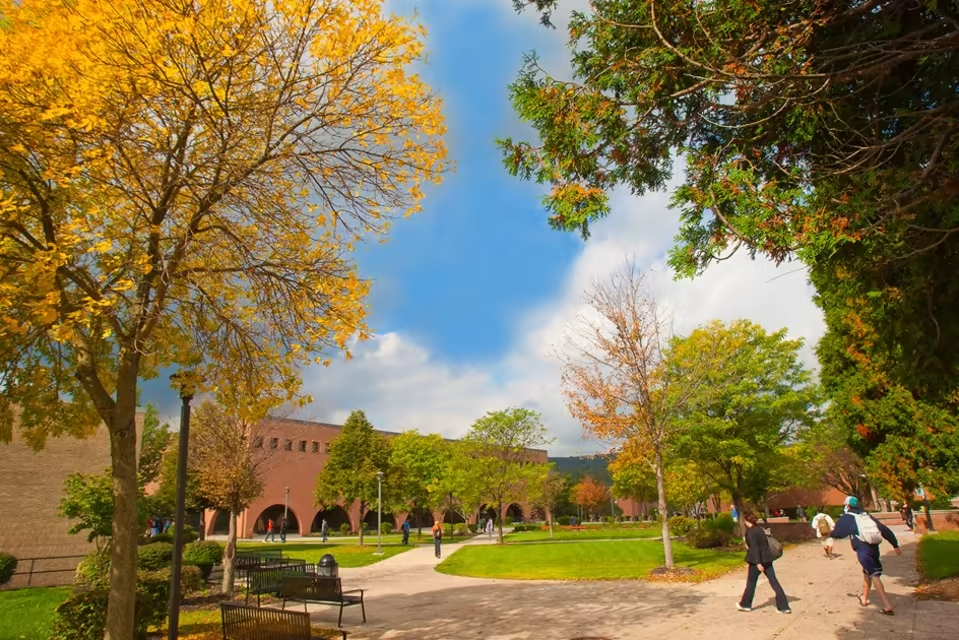
My wife and I are visiting relatives in and around her hometown of Cumberland, MD. Our lodging is the small mountain town of Frostburg – home of the Frostburg State Bobcats. While thinking of an article topic that might include Frostburg and UGA, I settled on examining some of the differences between Division I and Division II teams.
The easiest way to compare Georgia and Frostburg State football is by looking at their differences. Georgia is bigger, has more money, plays in the SEC, and often appears on national TV. Frostburg State is in Division II, has fewer resources, and gets less media attention.
All of this is accurate, but it doesn’t tell the whole story. Looking past the obvious differences gives us a more interesting perspective.
It’s not just about Georgia having more resources. Both Georgia and Frostburg State play the same sport, but Georgia plays in large stadiums with national TV coverage, while Frostburg plays in smaller places with less attention. Both teams recruit players, build depth charts, hire coaches, and aim for championships. Both ask their players to juggle school, practice, travel, pressure, and pain. The big difference lies in the support each team gets: Georgia receives substantial funding and attention, while Frostburg receives much less.
Georgia football is a national program in the strong SEC, with ample resources and broad reach. Frostburg State, on the other hand, is a well-known regional Division II team with a smaller staff and a different approach to competition. If Georgia is like an aircraft carrier, Frostburg State is more like a regional battleship. They are different in size and purpose, but both compete hard on Saturdays.
To really understand these differences, look at the team rosters. That’s where the gap is clear.
Georgia’s 2026 roster is a model for today’s SEC teams. Most players come from Georgia and the Southeast, but the team also recruits from across the country, including states like Connecticut, Illinois, and Nevada. The roster shows how transfers are now just as important as high school recruits.
This is how things work in the Power Four conferences. Georgia doesn’t just recruit high school players and wait for them to develop. The team builds its roster through high school recruiting, player development, player retention, the transfer portal, and careful planning. Every position is a mix of talent, strategy, and competition, with players from across the country, and is some cases – the world.
Frostburg State’s roster has its own story. The Bobcats mostly recruit players from Maryland, Pennsylvania, Virginia, West Virginia, and nearby states. This local focus doesn’t mean the players are less committed; it just shows a different recruiting approach. Frostburg State isn’t trying to get the same top recruits as Georgia, Alabama, or Ohio State. Instead, they look for players who fit Division II—those who might be overlooked, still developing, or not as big as major college players, or those who want to play where football is important but not a billion-dollar business.
The scholarship system makes this difference even clearer. Division I football changed after the House settlement, so schools that join now follow roster limits rather than the old scholarship caps for each sport. This means big programs can now fund their teams in ways they couldn’t before.
This difference in scholarships highlights the gap between divisions. Georgia builds its team with top recruits, shared revenue, and a strong national brand. Frostburg State has to use its limited resources carefully and develop players who might have been overlooked. Both ways show the different realities of college football.
Looking at how these differences play out, the next big contrast is in the coaching staff.
Georgia’s staff is more like a small city than just an office. Kirby Smart leads a large group of coordinators and coaches, along with a sizable support team that handles recruiting, operations, technology, nutrition, and other areas.
This isn’t just about having a lot of staff. It’s what drives a top SEC program. Georgia does more than coach players—they support them in every way. Staff members study opponents, evaluate recruits and transfers, make videos, manage nutrition and recovery, create recruiting materials, and always look for ways to get ahead.
Frostburg State’s staff is much smaller. Head coach Eric Wagoner, coordinators Trevor Miller and Eric Rhodes and their assistants take on many roles, including coaching, recruiting and more. At Georgia, these jobs are split among more people.
This doesn’t mean Frostburg State isn’t organized. It just means their coaches have to be more versatile. Georgia can hire specialists, but Frostburg State depends on coaches who do many different jobs. Both programs need skilled staff, but only Georgia can afford a large, specialized team.
Another way to compare the two programs is to look at who they play.
Georgia’s 2026 schedule is what you’d expect from a top SEC team: Tennessee State, Western Kentucky, Arkansas, Oklahoma, Vanderbilt, Alabama, Auburn, Florida in Atlanta, Ole Miss, Missouri, South Carolina, and Georgia Tech. The schedule includes nonconference games, big road trips, famous rivalries, and national matchups. Auburn and Alabama are always big games. Florida is still a tough opponent, even with the game in Atlanta. The season ends with the traditional rivalry against Georgia Tech.
Every Georgia game is part of a bigger national story. Each one affects playoff chances, how people see the SEC, and how coaches and players are judged. In this high-pressure setting, both the score and the story matter. Frostburg State’s season, on the other hand, is more about local and regional competition.
Frostburg State’s 2026 schedule is more regional and easier to travel, with games against Shepherd, Assumption, and Mountain East rivals like West Liberty, West Virginia Wesleyan, Concord, Glenville State, Charleston, Wheeling, West Virginia State, and Fairmont State. These games are less about TV and more about local pride. In 2025, Frostburg and Charleston shared the Mountain East title, and Frostburg reached the national quarterfinals.
This is important because Frostburg State shouldn’t just be seen as a side note. The Bobcats aren’t just there for Georgia fans to feel better about their own team. Frostburg State has made real progress. They moved up from Division III to Division II, became eligible for the playoffs, and have already made an impact in their league and the national playoffs. That’s a real achievement.
Maybe the biggest difference is in what the players themselves experience.
A Georgia player lives within a football apparatus that operates professionally long before the NFL arrives. Facilities, media focus, nutrition, training, travel, scouting, and scrutiny all converge on one goal: elite performance under relentless observation. A Georgia athlete can become a household name before starting a game—or the subject of online criticism before settling into campus life. That’s the bargain: a colossal platform weighed down by immense pressure.
A Frostburg State player has a more traditional college athlete experience, though it’s still demanding. There’s less national attention and fewer professional resources, so the pressures are different—more connected to campus life and less like the intense world of big programs such as Georgia.
This difference is what makes the comparison interesting and brings all the points together. It’s not about saying one program is better or more important. That kind of argument doesn’t hold up over time. Georgia and Frostburg State are made for different levels of football. Georgia aims for SEC championships, playoff spots, and national titles. Frostburg State focuses on winning in Division II, developing players, and moving up in its own way.
The main point is clear: Georgia and Frostburg State are different not just in size, but in how they are built. Georgia’s program shows what top-level college football looks like today, with national recruiting, big staffs, careful roster management, TV exposure, and high expectations. Frostburg State represents another important part of the sport, with regional recruiting, smaller staffs, partial scholarships, player development, and a strong conference identity.
Both teams play the same sport, but not under the same conditions. That’s what makes this comparison meaningful. Georgia shows college football at its most powerful. Frostburg State shows what the game looks like with fewer resources but still real stakes. Same field dimensions. Same collisions. Different worlds.
Jump To Today’s Discussion Thread